
Welcome to our Resource Centre
Your go-to hub for insights, tips, and expert advice on navigating the ever-evolving world of technology.
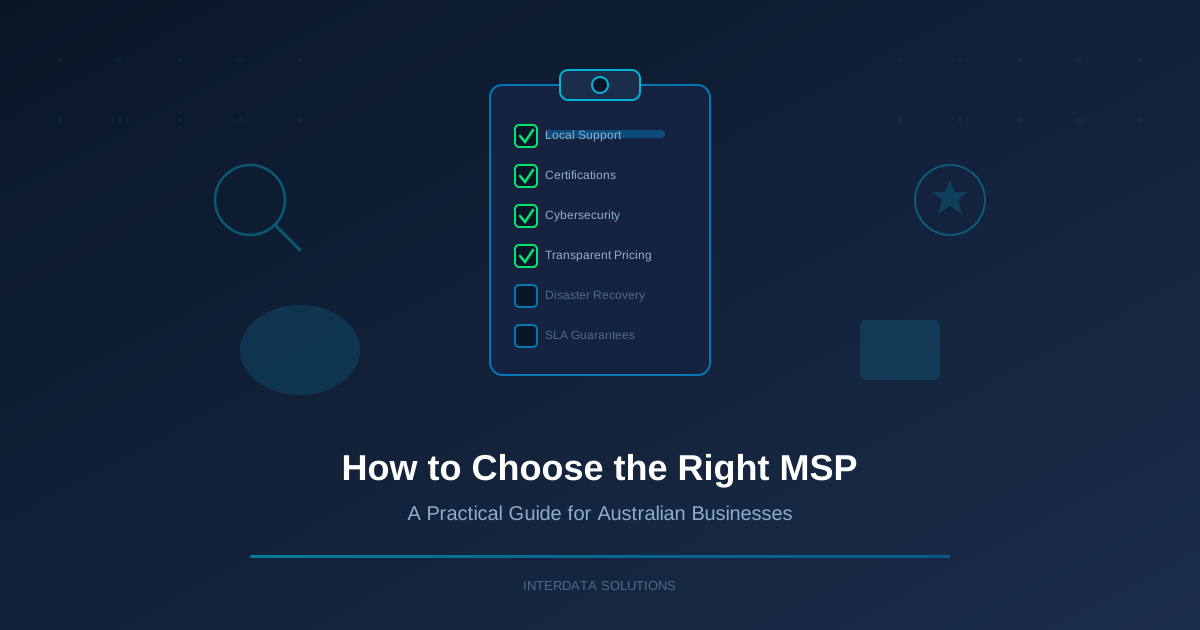
How to Choose the Right Managed IT Provider in Australia
Why Choosing the Right MSP Matters
Selecting a managed IT provider is one of the most consequential technology decisions an Australian small business can make. Your MSP will manage your network security, protect your data, maintain your cloud environment, and serve as the first responder when something goes wrong. A poor choice leads to slow response times, security gaps, unexpected costs, and technology that holds your business back rather than propelling it forward. The right MSP becomes a strategic partner that understands your industry, anticipates your needs, and scales with your growth. Australian businesses face specific requirements around data sovereignty, Privacy Act compliance, and local support availability that make this decision different from choosing a provider in other markets.
The 10 Factors That Matter Most
1. Local Presence and On-Site Capability
Remote support handles most issues, but some problems require hands on a keyboard. An MSP with technicians in your city can respond to hardware failures, network outages, and office moves without flying someone in. For Australian SMBs, this means choosing a provider with a physical presence in your state or region, not just a call centre overseas. Ask about average on-site response times and whether after-hours on-site support incurs additional charges.
2. Industry Experience
Every industry has specific compliance, software, and workflow requirements. A provider experienced with legal firms understands document management and matter-centric security. One experienced with healthcare knows My Health Record compliance and clinical system integrations. Ask your prospective MSP for client references in your specific industry and enquire about the regulatory frameworks they routinely support.
3. Cybersecurity Depth
In 2026, cybersecurity cannot be an afterthought or an add-on. Your MSP should include endpoint detection and response, email filtering, multi-factor authentication enforcement, and vulnerability management as standard components of their service. Ask whether they operate or partner with a Security Operations Centre for threat monitoring. Enquire about their incident response process and how quickly they can isolate a compromised device from your network.
4. Vendor Partnerships and Certifications
Legitimate MSPs hold current certifications from the vendors they support. For Microsoft environments, look for Microsoft Solutions Partner designations. For networking, look for Cisco or Fortinet partnerships. These certifications require ongoing training and competency validation — they indicate the provider invests in keeping their team current. Ask to see certification documentation rather than taking website claims at face value.
5. Transparent Pricing
The best MSPs provide clear, predictable pricing with no hidden fees. Understand exactly what is included in the monthly per-user or per-device fee. Common traps include extra charges for after-hours support, project work billed separately from BAU support, and onboarding fees that double the effective cost in year one. Request a full pricing schedule and ask specifically about scenarios that would trigger additional charges.
6. Backup and Disaster Recovery
Ask how backups are configured, how frequently they run, where backup data is stored, and how often recovery is tested. A quality MSP tests disaster recovery at least quarterly and can document recovery time objectives for your critical systems. Data sovereignty matters for Australian businesses — confirm that backups are stored in Australian data centres unless you have a specific reason to use offshore storage.
7. Response Time Guarantees
Service Level Agreements should specify response and resolution times by priority level. A critical system outage should receive a response within 15 to 30 minutes. Standard requests should be acknowledged within one to two hours. Ask for the MSP’s actual performance against their SLAs over the past 12 months — any reputable provider will share this data.
8. Scalability
Your MSP should be able to grow with your business without requiring a complete platform change. Ask how they handle adding new users, new offices, or new cloud workloads. Understand whether their pricing model incentivises growth or penalises it. A provider that charges a flat per-user rate with volume discounts is aligned with your scaling trajectory.
9. Strategic Planning and Reporting
Beyond daily operations, a quality MSP provides quarterly technology reviews, annual budget planning, and regular reporting on system health, ticket trends, and security posture. This strategic layer is what separates a true managed service from basic outsourced help desk support. Ask to see a sample quarterly business review to understand the depth of insight you will receive.
10. Cultural Fit and Communication
You will work with your MSP daily. Their communication style, responsiveness, and willingness to explain technical concepts in business terms matters as much as their technical capability. During evaluation, note how quickly they respond to your enquiries, how clearly they explain their services, and whether they listen to your needs or push a standard package.
Frequently Asked Questions
How long should I commit to an MSP contract?
Most Australian MSPs offer 12 to 36 month agreements. A 12-month term gives you flexibility to switch if the relationship does not work, while a 24 to 36 month term often comes with better pricing. Avoid providers that require long-term commitments without a performance-based exit clause. A confident MSP will include a 90-day termination clause tied to documented SLA failures.
Should I choose a local or national MSP?
For businesses with a single office, a local MSP with on-site capability is usually the best fit. For businesses with multiple locations across Australia, a national provider with regional technicians offers consistency. The key factor is not size but whether the provider can deliver responsive support at every location where you have staff.
What questions should I ask during an MSP evaluation?
Ask for their average ticket resolution time over the past six months, their client retention rate, how they handle after-hours emergencies, what their onboarding process looks like, and whether you will have a dedicated account manager. Request references from clients of similar size and industry. Ask about their staff turnover rate — high churn at an MSP means you will constantly be re-explaining your environment to new technicians.
How do I transition from one MSP to another?
A professional MSP will support a clean transition. This includes providing complete documentation of your environment, transferring administrative credentials, and cooperating with your new provider during the handover period. Budget four to six weeks for the transition. Your new MSP should manage the process and minimise disruption to your team.
What does a managed IT service typically cost in Australia?
For Australian SMBs, managed IT services typically range from $100 to $250 per user per month depending on the scope of services, security requirements, and complexity of your environment. A business with 20 users should expect to invest $2,000 to $5,000 per month for comprehensive management including cybersecurity, help desk, monitoring, and strategic planning.
Ready to Evaluate Your Options?
Interdata Solutions is a Sydney-based managed IT provider serving Australian SMBs nationally. We hold Microsoft Solutions Partner and Cisco Select Partner certifications, operate with transparent per-user pricing, and provide quarterly business reviews as standard.
Book a free consultation: Schedule a call
Call us: 1300 130 931
Email: [email protected]


1300 130 931
Level 57, 19-29 Martin Place, Sydney NSW 2000
Monday - Friday, 9:00 am - 5:00 pm
© Copyright 2026. Interdata Solutions Pty Limited. All rights reserved.